
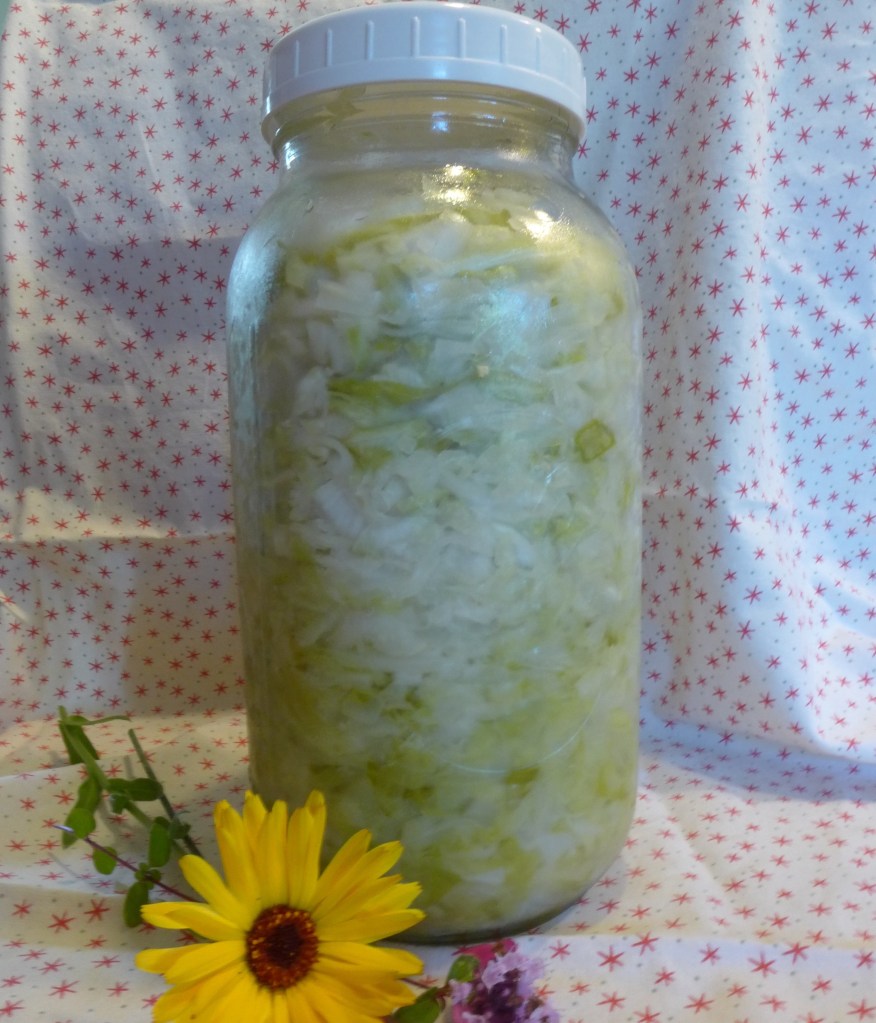
Fresh, delicious, with just enough zip from the garlic and onion. It can be a tasty side dish for any meal.
- 1 head; 2-pounds, green cabbage
- 4 teaspoons kosher salt (1 teaspoon per half-pound of cabbage)
- 1 medium white onion, or 4 small spring onions, sliced into thin half-moons
- 4 cloves garlic, minced
Weigh head of cabbage.
Cut cabbage head in half, cutting it north to south, so you are cutting through the core. Cut in quarters, cutting the same direction, through the core. Cut the core away from each quarter. Discard the core.
Slice each section into 1/8 inch ribbons, and place them into a large bowl.
Add 1 teaspoon of salt per ½ pound of the whole cabbage weight. Sprinkle salt over the shredded cabbage.
Prepare the onions and garlic, but don’t add them to the cabbage, yet.
The pre-salting of the cabbage will give it a chance to begin releasing water.
With clean hands, begin massaging the cabbage. Grab it hard, and move it around to massage each shred. Massage for at least 3 minutes (set a timer). The cabbage should reduce by about half in volume.
Add the onion and garlic. Mix well.
Place the mixture in a fermentation vessel. Half gallon canning jars are great for this, as are ceramic crocks. One quart, wide mouth canning jars will do also, but you will need 2 of them.
Add some cabbage to the container and compress after each scoop. Use your fist to press the mix into the bottom of the vessel, making sure the vegetables are tightly compacted. There should be enough liquid from the cabbage to cover the vegetables.
Place a weight on top of the mix to keep it covered with liquid. When using a canning jar, you can fill a thin glass (or ½ pint jam jar) with water and set this on top of the mix.
Cover the vessel with a cloth to keep the dust and un-savories from getting inside. Set the vessel in a dish to catch any liquid over-flow when the fermentation begins.
Leave the vessel on the counter. Visit if often the first day to make sure the weight is keeping the mixture submerged. After 3 days, taste it! It will probably need several more days to achieve proper sourness.
Once you are happy with the flavor, move the new sauerkraut to the refrigerator in a covered container. If you used a canning jar, just add a lid.
It will continue to ferment, but at a much slower pace.
Preparation time: 15 minutes
Fermentation time: 3 days minimum
Yield: 1 ½ quarts
Note: the Sauerkraut may turn soft if your house temperature rises above 75oF during the fermentation.
Recipe revised by Jane Blaisdell, 2019. Original recipe by Cynthia Lair, 2014.

 made simply, by jane